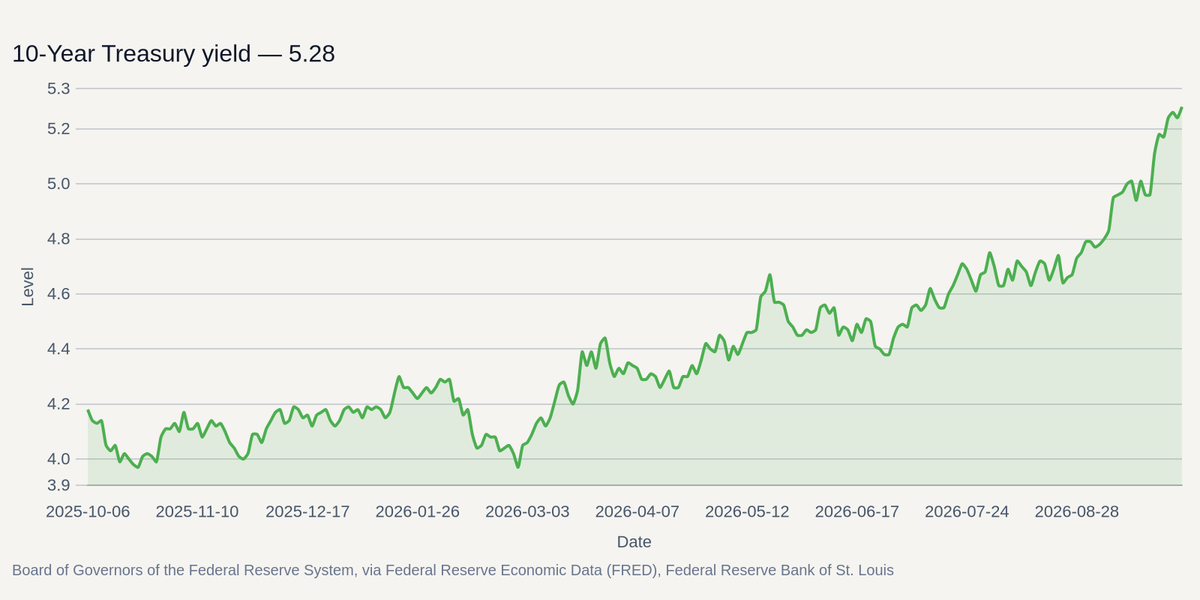
Monday's price action delivered a textbook contradiction. The Nasdaq Composite sailed to a record 27,477 and NVDA printed fresh all-time highs, right alongside the 10-year Treasury yield surging past 5.31% to levels unseen since 2002. In a vacuum, a spike in the discount rate mechanically crushes long-duration growth equities.
Instead, mega-cap tech has completely decoupled from the bond market, functioning almost as an inverse trade to the broader macro environment.
The Anatomy of Yield Immunity
This is not blind artificial intelligence euphoria; it is pure balance sheet physics. The largest technology leaders generate so much free cash flow that their cost of capital is effectively untethered from the Federal Reserve. When debt gets expensive (which, as a reminder, acts as mechanical gravity on anything requiring external funding), companies like Apple and Alphabet simply self-fund their server clusters while smaller competitors choke on double-digit borrowing costs.
The sector's structural profitability premium over broader equities justifies this safe-haven behavior . Tech acts defensively precisely because these fortresses operate with virtually zero reliance on credit syndicates to fund daily operations.
The $700 Billion Capex Debt Trap
But the AI infrastructure race is stress-testing that armor. Hyperscaler capital expenditures are projected to approach $700 billion in 2026, forcing a negative free cash flow inflection point for some operators and necessitating record debt issuance .
The perception of total insulation is quietly eroding beneath the surface. As debt supply from hyperscalers hits unprecedented volumes, lenders are scrambling for protection and actively scrutinizing AI-driven corporate debt . Suddenly, borrowing spreads and debt servicing costs actually matter to companies that previously printed cash without consequence.

Hardware Winners vs. Cloud Landlords
The market is already separating the true cash generators from the debt-reliant infrastructure builders. Investors reward direct revenue conversion but ruthlessly penalize operators using balance sheet leverage to fund unconstrained infrastructure growth .
NVIDIA remains the ultimate insulated play, capturing outsized cash flows without bearing the massive, long-term real estate risk of housing the servers. Meta Platforms funds its compute buildouts straight from its digital advertising margins, maintaining pristine leverage metrics. Conversely, Amazon and Microsoft are walking a tighter rope, balancing immense Azure and AWS real estate commitments against their high-grade balance sheets (with Microsoft defending one of corporate America's last two triple-A ratings).
Q3 Capex Guidance as the Final Litmus Test
The upcoming earnings season will force companies to show their math. Starting late October, GOOGL and AMZN report Q3 results and update full-year capex guidance while providing preliminary outlooks for FY2027, offering the concrete numbers credit markets need to price future debt packages.
Adding pressure, a wave of mega-cap AI public offerings is expected to compete directly for capital, threatening to absorb incremental equity liquidity away from the incumbents . Across the 10,000+ tickers in our coverage universe, Scouter helps you assess setups like this by tracking the Mega-Cap Tech Cost of Capital Insulation trend against historical volatility. The true diligence question is no longer just who has the best silicon—it is identifying whose balance sheet cracks first under a 5.3% yield environment.