
A federal judge delivered a striking blow to the Trump administration on Friday, blocking the Justice Department from serving subpoenas to Federal Reserve Chair Jerome Powell. The ruling declared that the administration had produced "essentially zero evidence" of a crime, explicitly identifying the investigation as a pretext to force the Fed chief to slash interest rates.
This unprecedented level of executive pressure on the central bank is sending shockwaves through global markets. While broad equities closed the week in the red—with the Nasdaq slipping 0.93% on Friday—the real story lies beneath the major indices. The erosion of central bank independence is triggering a massive, defensive reallocation by global institutions.
To understand the gravity of the current tension, one only needs to look at the interest rate environment. As the chart below illustrates, the Fed's aggressive multi-year campaign to normalize rates has kept borrowing costs at their highest levels in decades, setting the stage for this week's political collision.
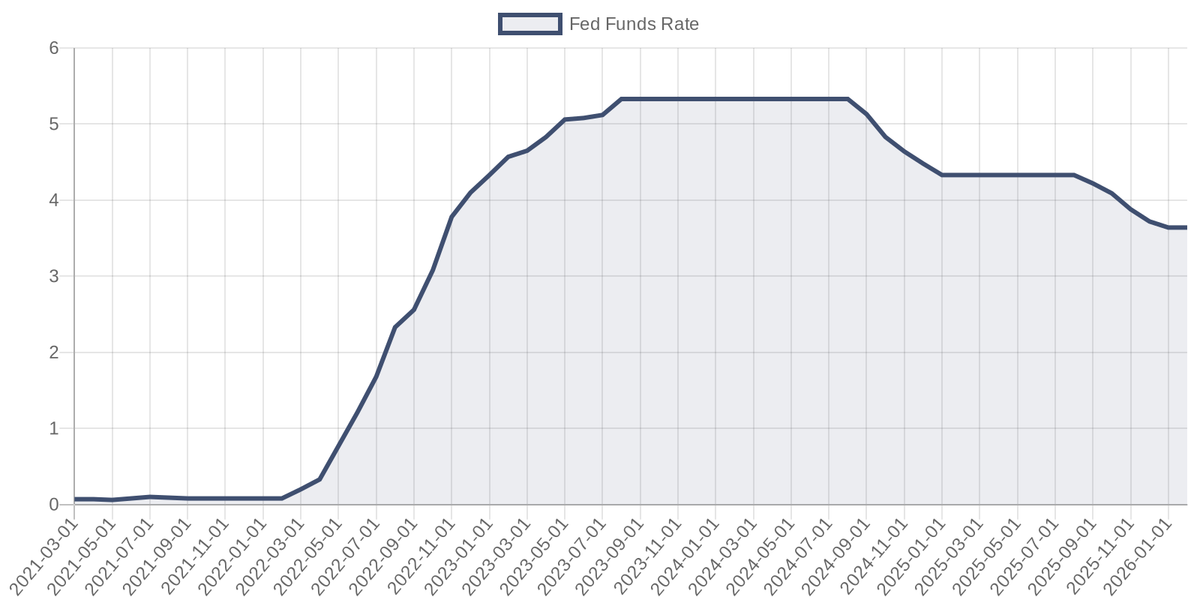
According to data from Reuters, the subpoena block has only heightened the stakes ahead of Powell's term expiration in May 2026. The political theater is simultaneously delaying the confirmation of Kevin Warsh, the administration’s pick to succeed Powell, leaving the world's most critical monetary institution in a state of leadership limbo.
The Institutional Pivot to Sovereign Risk Hedging
For investors, the immediate takeaway isn't just about Washington's legal battles; it's about the weaponization of monetary policy and the resulting surge in fiscal deficits. This backdrop is pouring fuel on the Hard Asset & Sovereign Risk Hedging trend.
Scouter AI data shows this theme is flashing a massive 9/10 Catalyst score. Global central banks and institutional managers are actively hedging against fiat debasement and fiscal dominance by accumulating non-sovereign reserves.

As confidence in the US dollar’s insulation from politics wavers, capital is flowing directly into gold and its proxies. GLD remains the primary vehicle for direct physical exposure. However, investors looking for leveraged free cash flow are turning to major miners. NEM, the world's largest gold producer, and AEM, a premium miner operating strictly in geopolitically safe jurisdictions, are becoming heavily trafficked safe havens.
Furthermore, the "digital gold" narrative is catching institutional bids, with IBIT serving as a decentralized alternative for those looking to sidestep central bank influence entirely.
The Contrarian Threat to the Hard Asset Trade
While the momentum behind gold and non-fiat assets feels unstoppable (registering a Hype score of 8/10), the trade is becoming crowded. The primary risk to this bullish hard-asset narrative is a sudden restoration of institutional order.
If Kevin Warsh—a known inflation hawk—navigates the current Senate delays and is confirmed smoothly, his leadership could quickly restore confidence in the Fed's independence. A hawkish, credible central bank would strengthen the US Dollar and dramatically increase real yields. Additionally, if recent oil price surges embed stubborn inflation into the economy, the Fed may be forced to hold or hike rates. In a high-yield environment, the opportunity cost of holding zero-yielding assets like GLD becomes a severe headwind.

Looking Ahead
The macro calendar is dense with potential flashpoints. March's French Municipal Elections are poised to signal rising Eurozone political risk, while upcoming G7 emergency meetings regarding massive Strategic Petroleum Reserve (SPR) releases could drastically alter the inflation outlook by April.
For now, the focus remains squarely on the Fed. As long as the central bank's independence remains a political target, the structural bid for Hard Asset & Sovereign Risk Hedging will likely persist, forcing investors to prioritize portfolio durability over traditional growth.