
The financial sector spends the back half of June preparing its balance sheets for inspection, and the final days of the month are when the bill comes due. Whether a company is selling off consumer loans, outsourcing hurricane exposure, or proving its solvency to the Federal Reserve, the underlying mechanic is the same: paying a premium to transfer structural risk.
This week brings definitive scorecards for capital buffers and liquidity across Financials. The setups test how effectively lenders and insurers can manage their cost of capital while defending their margins against worst-case macro scenarios.
Oportun’s Securitization Squeeze
OPRT runs a high-wire act with roughly $2.7 billion of debt resting on $396 million of equity. The cost of financing that leverage dictates their entire unit economics, making capital markets access their single most important fundamental variable. On Wednesday, July 1, 2026, the non-prime lender faces a critical test of that access via an H1 asset-backed securitization (ABS) or major debt refinancing.
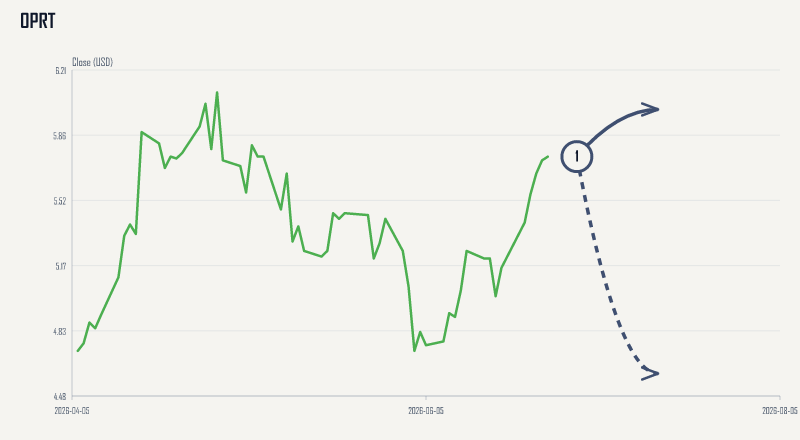
The company recently installed a new chief risk officer , a clear signal to underwriters that management is tightening the screws on credit quality ahead of these transactions. Scouter's modeled move window for this catalyst resolves by Wednesday, July 15, 2026. A clean transaction with attractive spreads could push the stock toward a modeled $6.00 target, validating their durable funding model.
In the current rate environment, extending maturities or modestly lowering the all-in funding cost would be broadly interpreted as de-risking the enterprise. If spreads widen materially or Oportun is forced to accept restrictive covenants that signal lender caution, the downside scenario models a floor near $4.60.
Hippo Prices the Hurricane Season
Property insurers are entirely captive to the cost of offloading their tail risks. For HIPO, the mid-year reinsurance renewal and catastrophe program update effective Wednesday, July 1, 2026, will dictate underwriting margins heading straight into peak Atlantic hurricane season.
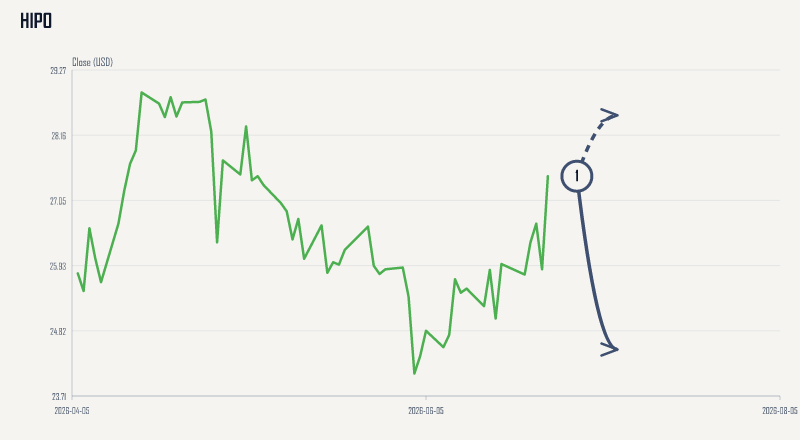
While the company confirmed the placement of its core 2026 reinsurance program earlier in June , this week's program update in Scouter's model captures the actual margin transmission and capacity realities. Although Hippo secured its coverage at a 15% to 20% rate decrease relative to risk-adjusted flat pricing, any unexpected friction in the broader treaty market could still squeeze the profitability Hippo recently established in the first quarter (where it posted a net income of $7 million, reversing a steep loss from a year ago). The modeled outcome window for this transmission resolves by Wednesday, July 8, 2026.
Assuming favorable terms that protect the balance sheet without cannibalizing net income, Scouter assigns a 45% bull probability for a push toward $28.50. If the structural cover proves too restrictive or expensive, leaving the company exposed to late-summer weather volatility, it threatens a drag back to the $24.50 floor.
Regions Preferreds and the CCAR Checkpoint
The preferred equity of regional banks serves as a pure proxy for perceived tail risk. Holders of RF-PC sit directly above common equity, meaning their primary concern is the thickness of the capital cushion beneath them. That cushion gets stress-tested on Tuesday, June 30, 2026, with the release of the Comprehensive Capital Analysis and Review (CCAR) and supervisory capital plan.
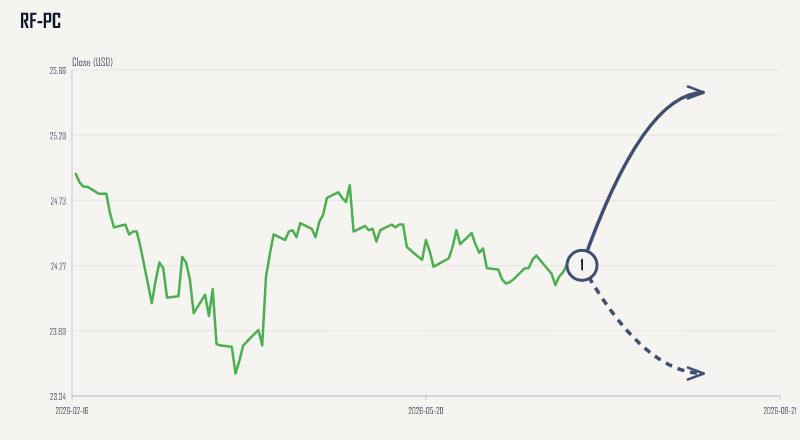
Regions has steadily built its equity base to roughly $19 billion, providing a highly defensive capital profile heading into the print. Markets generally expect fewer regulatory surprises in the current policy environment, and a clean stress test outcome would quickly narrow any lingering tail risks. Scouter's modeled move window for the CCAR fallout resolves by Saturday, August 1, 2026.
If regulators sign off on the capital plan without constraining dividends or flagging commercial real estate vulnerabilities, RF-PC should grind toward $25.50 as yield compression resumes. Any hint that stress losses bite into those equity buffers could pull the shares back toward $23.50 as income investors reprice the required risk premium.
The Cost of Structural Safety
Whether an institution is selling off loan tranches into an ABS, transferring weather exposure to global reinsurers, or hoarding common equity to appease regulators, risk transfer is the hidden toll road of the financial sector. The companies that navigate this week successfully are simply those that can buy structural safety without destroying their own unit economics in the process.
For investors, these catalysts offer a rare look under the hood at actual institutional confidence. Earnings calls can be massaged with adjusted metrics, but you cannot fake the spreads demanded by a securitization underwriter or a reinsurance syndicate.