
A constructive tone has taken hold of broader markets heading into the new week, following a tech-led rally that saw the Nasdaq Composite finish last Friday up 1.71% as investors looked past near-term rate jitters. But beneath the macro index optimism, the week of May 11–17 brings a demanding slate of fundamental reality checks. The focus shifts toward companies trading at compressed multiples that must now prove their cash flows and regulatory maneuvering can hold up.
This week’s Scouter Top Ideas roadmap homes in on three key setups across Consumer Discretionary, Information Technology, and Utilities. Each name faces a critical inflection point where execution must justify a multiple re-rating or risk a punishing guidance reset.
Testing Enrollment Resilience in For-Profit Education
For PRDO, the core debate centers on margin stability and the durability of its revenue growth. The for-profit education operator sits at an interesting crossroads: it has historically generated strong cash flow and maintains a solid balance sheet, but the broader consumer tape shows signs of exhaustion.
Perdoceo reported first-quarter 2026 results and a guidance update on Thursday, May 7, 2026, and at the time of that release the stock was trading around $33.52, implying a forward P/E in the low-teens versus a sector average that is higher. Management said it continued to convert student enrollment into free cash flow .
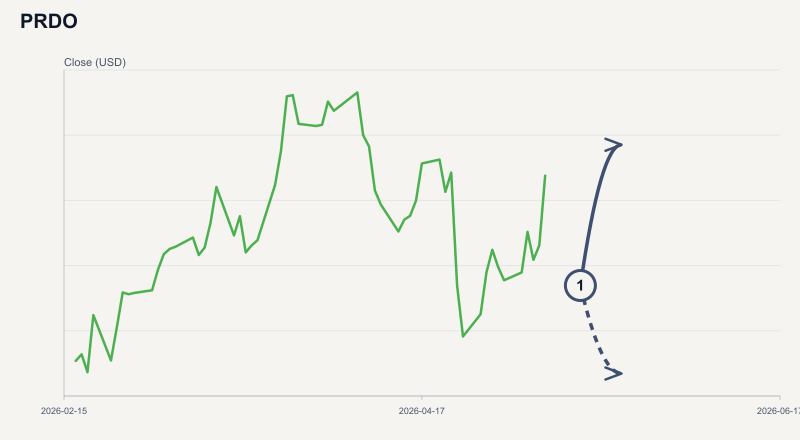
Our modeled scenario work suggests a 57% probability of a bullish outcome for the latest print. If Perdoceo delivers a clean beat-and-raise, confirming that student acquisition costs are contained and enrollment remains insulated from broader labor market shifts, the stock could move toward a $36.75 target. However, the Education Services space remains highly sensitive to regulatory headline risk. Any signals of stalling enrollment or conservative full-year guidance would likely be punished in a tape that has been unforgiving to consumer misses, pulling shares back toward a $31.50 floor.
Subscription Cash Flow Against an $8.2 Billion Debt Wall
Transitioning to the software infrastructure side, GEN faces a pivotal test. The company has aggressively scaled its consumer cybersecurity portfolio, recently saying it crossed the $5 billion mark in fiscal 2026 revenue, with growth accelerating to double digits .
The company also disclosed a debt load of about $8.2 billion, which remains a key overhang in a higher-for-longer interest rate environment.

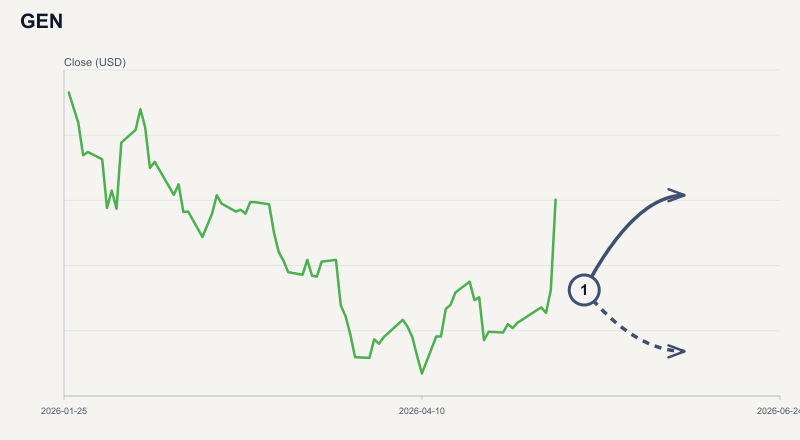
The Q4 FY2026 earnings release and call were centered less on the rear-view mirror and more on FY2027 guidance and free cash flow allocation. The broader tech sector has seen a rash of bearish post-earnings reactions driven by inflated expectations, but Gen Digital’s low multiple provides a valuation floor in our view. If management can affirm robust consumer subscription resilience and commit to aggressive debt paydown, our expected move model targets a rally toward $22.80. The flip side—a consumer spending slowdown that forces a downward revision in FY27 guidance—could easily crack support and send the name testing $18.50.
Rate-Base Growth and the California Wildfire Overhang
In the regulated utility space, EIX (Edison International) offers one of the most polarizing setups of the week. In its latest reported quarter, the company posted a sharply higher profit year over year, helped by California rate increases and other regulatory cost-recovery mechanisms, according to Reuters .
The stock continues to trade at a discount to the broader utility group, with wildfire liability in California remaining the central overhang. EIX has also taken steps to address that risk, with Southern California Edison saying it has offered more than $500 million in relief to community members impacted by the Eaton Fire . But investors remain skeptical about long-term equity value when grid-hardening capital needs and California's inverse-condemnation framework continue to loom.

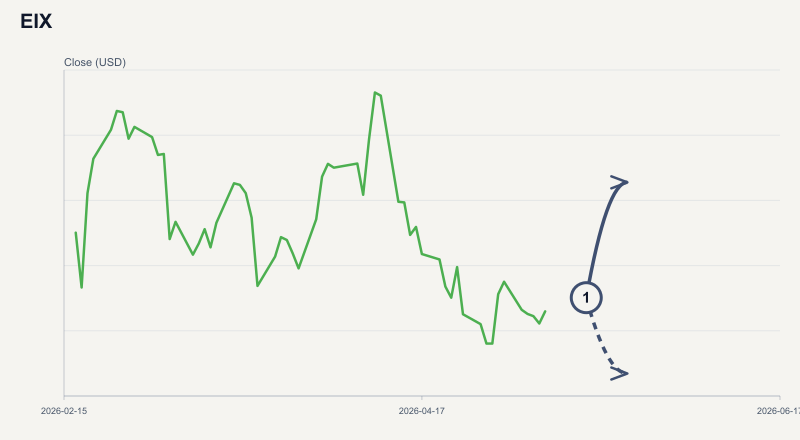
With the first-quarter print and updated 2026 guidance already in hand, the next test is whether management can sustain its stated earnings growth profile while limiting any need for incremental equity financing. The shares have recently been trading below their medium-term trend, and sentiment remains cautious. If EIX reaffirms its guidance and keeps mitigation costs contained, the stock could re-rate modestly from current levels. By contrast, any sign that wildfire-related costs are escalating faster than expected, or that equity issuance may be needed, would likely pressure the shares further.