
President Trump’s Saturday announcement of a blanket 15% global tariff—just 24 hours after the Supreme Court struck down his previous trade framework—has injected a fresh shock into the global economic landscape. While the rapid-fire policy shift creates chaos for importers and retailers, it is acting as a powerful accelerant for the Global Rearmament & Trade Fortress trend, which Scouter AI has flagged as a high-conviction theme for early 2026.
The "Why Now": Policy Chaos Breeds Fortress Economics
On Friday, the Supreme Court ruled that the administration’s use of the International Emergency Economic Powers Act (IEEPA) to impose tariffs was unconstitutional. In a defiant pivot, President Trump utilized Section 122 of the Trade Act of 1974 to not only reinstate levies but raise them to 15% "effective immediately," according to a post on Truth Social.
This erratic policy environment reinforces a "Fortress America" narrative. As global trade friction rises, nations are prioritizing self-sufficiency and security over efficiency. This geopolitical hardening is directly feeding into the defense sector, which is increasingly viewed as a structural hedge against trade volatility.
Connecting the Dots: Scouter Data & Catalysts
While the broader market digests the inflationary implications of a 15% import tax, the Industrials sector—specifically Aerospace & Defense—is decoupling from the fear. Scouter AI’s deep dive into the Political Risk & Global Trade Policy sector reveals a "Hype" score of 8/10 and a "Catalysts" score of 9/10, driven by tangible government spending commitments rather than speculation.
Key Catalysts driving this week’s action:
- Enforce Tac 2026 (Feb 23-25): Starting tomorrow in Nuremberg, this key trade show is expected to generate significant contract news for European defense players like Rheinmetall AG, capitalizing on Germany's *Zeitenwende* budget expansion.
- US FY2027 Budget: The upcoming request in March/April is expected to confirm a push toward a $1.5 trillion defense topline, supporting prime contractors despite fiscal deficit strains.
Chart of the Week: The Defense Premium
Investors are already positioning for this shift. Lockheed Martin, a primary beneficiary of U.S. and allied air defense spending, has seen sustained momentum as global friction translates into order backlog.
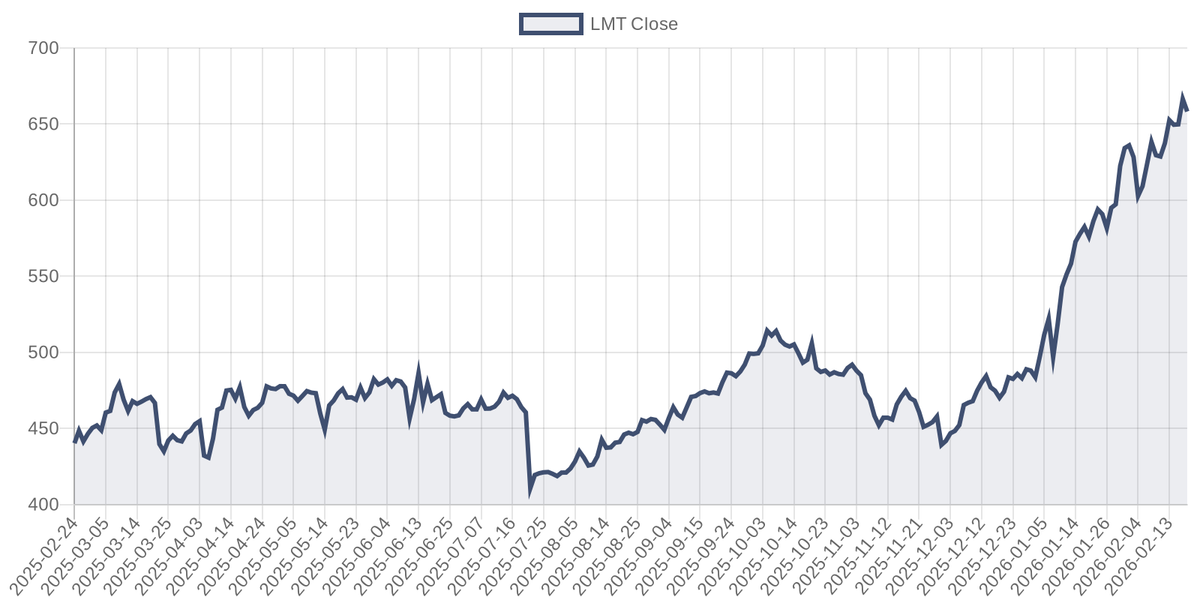
As the chart above illustrates, Lockheed Martin has maintained a bullish trajectory over the last year, reflecting the market's realization that defense spending is non-discretionary in a fragmented world. The stock’s resilience stands in contrast to retail-exposed names that may suffer under the new tariff regime.
The Macro Ripple: Inflation and the Fed
The re-imposition of tariffs complicates the Federal Reserve’s path. Friday's data showed core inflation running at a 3% annual rate in December, according to recent Commerce Department reports. The Supreme Court's ruling briefly offered hope of disinflation, but Trump's 15% counter-move reignites price pressure risks.
If import costs rise, the "soft landing" narrative faces headwinds. Markets have already rolled back bets on rate cuts, pushing expectations out to July. In this environment of "higher for longer" rates and sticky inflation, companies with government-backed cash flows—like RTX Corp and Mitsubishi Heavy Industries—offer a defensive moat that purely commercial cyclicals lack.
The Scouter Edge
The "trade war" headline is noise; the signal is rearmament. While algorithms may sell the broad market on tariff fears, the smarter capital is flowing into the hardware of national security. With the Global Rearmament trend scoring high on proprietary metrics, the pullback in broader indices may offer an entry point for defense primes poised to capture the increased spending from the U.S., Japan, and Germany.