
The U.S. labor market has undergone a radical phase shift. The frenetic churn of the "Great Resignation" has evaporated, replaced by what economists are calling the "Big Stay." For the broader economy, stability might seem like a virtue, but for the staffing industry, it is an existential headwind.
On a day when the Nasdaq slipped 1.59% and investor sentiment turned decidedly cautious, the stagnation in the Professional Services sector offers a critical signal: the labor market isn't crashing, it's freezing. Companies are hoarding talent rather than hiring, creating a friction that is directly eroding the business models of sector heavyweights like Robert Half Inc. and ManpowerGroup.
The Economics of the 'Labor Funk'
Staffing firms thrive on volatility. They generate fees when employees leave and companies scramble to backfill roles. When the quit rate collapses to multi-year lows, that revenue stream dries up. Scouter AI's analysis of the "Labor Funk" Stagnation trend highlights a "No-Go" rating for the group, driven by a trifecta of structural issues:
- The Big Stay: Turnover has hit a floor. Employees, uncertain about the economic horizon, are clinging to their current seats.
- Margin Protection: Corporate clients are freezing headcount to protect their own margins rather than expanding.
- AI Displacement: There is a growing structural fear that Generative AI is permanently eroding demand for the entry-level administrative and clerical roles that have historically been the bread and butter for firms like RHI.
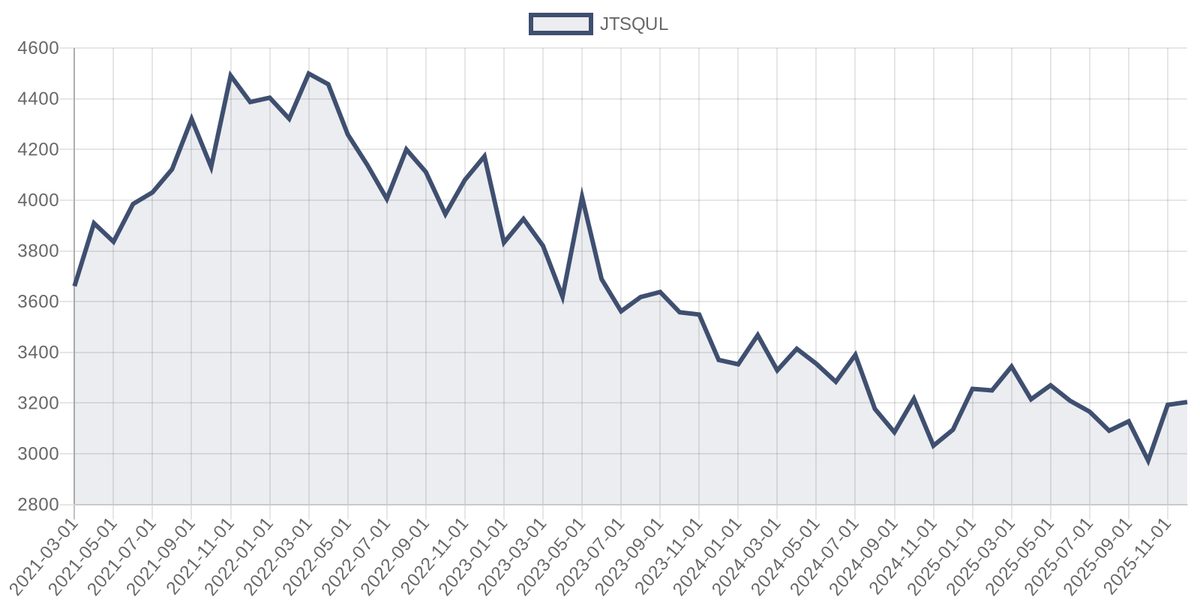
As the chart below illustrates, the voluntary quit rate—a proxy for worker confidence and staffing churn—has reverted sharply from its post-pandemic highs.
Valuation vs. Value Trap
To the untrained eye, the sector looks cheap. Valuations have compressed significantly, with many names trading at price-to-earnings (P/E) ratios below 12x. However, Scouter AI data suggests this is a classic "Value Trap."
Institutional capital appears to be rotating out of the space, not because the price is wrong, but because the growth narrative is broken. Without a resurgence in hiring volumes—driven either by a return of confidence or a spike in turnover—these stocks lack a catalyst to re-rate higher.
The Macro Disconnect
While the market awaits the long-term impact of Federal Reserve policy, the transmission mechanism is proving slow. Rate cuts expected throughout 2026 are theoretically designed to lower capital costs and restart project-based hiring. However, until those rates materially impact corporate CAPEX budgets, the "transmission lag" leaves staffing firms in limbo.
Even AMN Healthcare, typically a defensive hedge due to the non-cyclical nature of healthcare, is not immune to the broader trend of hospital systems tightening budgets.
What to Watch
Investors looking for a bottom should ignore the raw valuation metrics and focus on the macro data. The sector needs a "Goldilocks" scenario—economic data hot enough to spur hiring but cool enough to keep rates falling. Until the Bureau of Labor Statistics reports a meaningful uptick in job openings and quits, the staffing sector is likely to remain dead money in a churning market.