
The release of Jamie Dimon’s annual shareholder letter has injected a potent dose of macro anxiety into an otherwise buoyant market. Warning of a "bad confluence of events," the JPM chief executive highlighted the ongoing war in Iran, the recent March 2026 oil supply shock, and the risk of stickier-than-expected inflation. If inflationary forces outpace deflationary ones, Dimon cautioned, the global economy could face a 1970s-style stagflation scenario. Yet, beneath these stark geopolitical warnings, the Financials sector is quietly executing a massive structural pivot.
While Dimon scans the horizon for private credit risks and supply chain disruptions, large-cap banks are rapidly transitioning from a reliance on net interest income (NII) to a "fee machine" model. Driven by a major resurgence in M&A advisory, capital markets, and wealth management, this Banking revival is anchoring the sector’s profitability even as traditional lending margins plateau.

As the sector’s undisputed bellwether, JPM is the focal point of this transition. The stock has enjoyed a significant rally over the past year, leaving analysts debating whether current valuations are priced to perfection. As the chart below shows, JPM shares have trended heavily upward over the past twelve months, currently trading near $294.60.
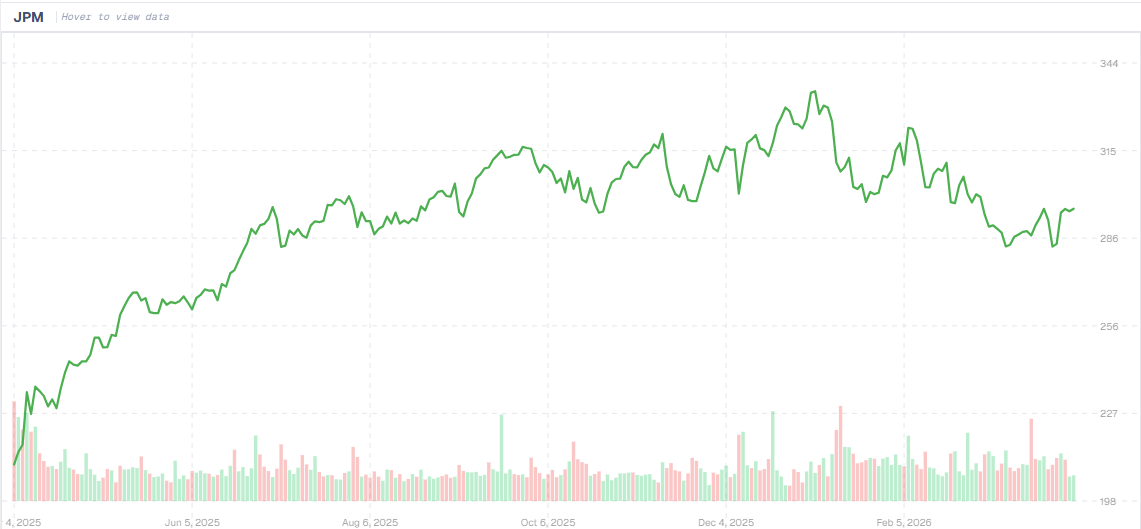
This elevated base sets a high bar heading into the bank's April 10 Q1 earnings release. Investors will be looking for confirmation that trading and investment banking fees can offset incremental pressure on net interest margins. Scouter AI analysis indicates that a clean earnings beat and constructive forward guidance could propel shares toward the $312 level. Conversely, any signs of accelerating consumer credit reserving or softer fee outlooks could push the stock back toward the $276 area as markets digest the print.
The broader institutional backdrop adds another layer of complexity. With the Federal Reserve funds rate parked at 3.64%, the banking industry is operating in a stabilized "neutral" rate environment. However, Dimon’s warning that inflation could slowly grind higher—forcing the Fed to rethink its rate path at the upcoming April 29 FOMC meeting—threatens to squeeze deposit betas and stifle loan demand. Counterbalancing this hawkish risk is the current regulatory landscape. A newly proposed easing of capital regulations, with a 90-day consultation period ending in June 2026, is acting as a powerful tailwind for bank capital return plans under the current administration.
Of course, the bullish "fee machine" narrative is not without its vulnerabilities. While M&A activity is thawing, consumer balance sheets are showing signs of strain. Rising delinquency rates and localized credit card risks are surfacing across the industry. Furthermore, a politically proposed 10% credit card interest rate cap hangs over the consumer banking segment, threatening to kneecap a historically reliable revenue stream just as lending margins tighten.

Looking ahead to the mid-April Q1 earnings "litmus test," the divergence between diversified giants and pure-play lenders will become starker. Institutions with robust advisory and wealth management arms—such as GS and MS—are best positioned to capitalize on the capital markets thaw. Meanwhile, investors seeking discounted multiples might look toward highly-rated regional players like EWBC, which offer compelling 2026 earnings growth trajectories. For the broader market, the question isn't just whether Dimon's geopolitical fears materialize, but whether Wall Street's renewed fee engines can outrun them.