
While Tuesday's session saw the Nasdaq rebound over 1% and the S&P 500 snap a losing streak, smart money isn't chasing the rally—it's hiding in the aisles of your local grocery store.
Beneath the surface of this week's green screens, a distinct capital rotation known as the "Defensive Trade-Down" is hardening. Since late January, while the tech-heavy Nasdaq 100 has corrected approximately 5%, the Consumer Staples sector has surged, with key names up over 13% year-to-date. This divergence signals that institutional investors are positioning for a "stable but cautious" consumer environment, favoring cash-flow reliability over growth volatility.
The Consumer: Confident but Calculating
Data released this week supports this thesis. The Conference Board reported that consumer confidence rebounded in February to 91.2, driven largely by a resilient labor market. However, the details reveal a more nuanced picture: expectations remain below the critical 80 level often associated with recessions, and "comments about prices, inflation and the cost of goods remained at the top of consumer's minds," according to the Conference Board report.
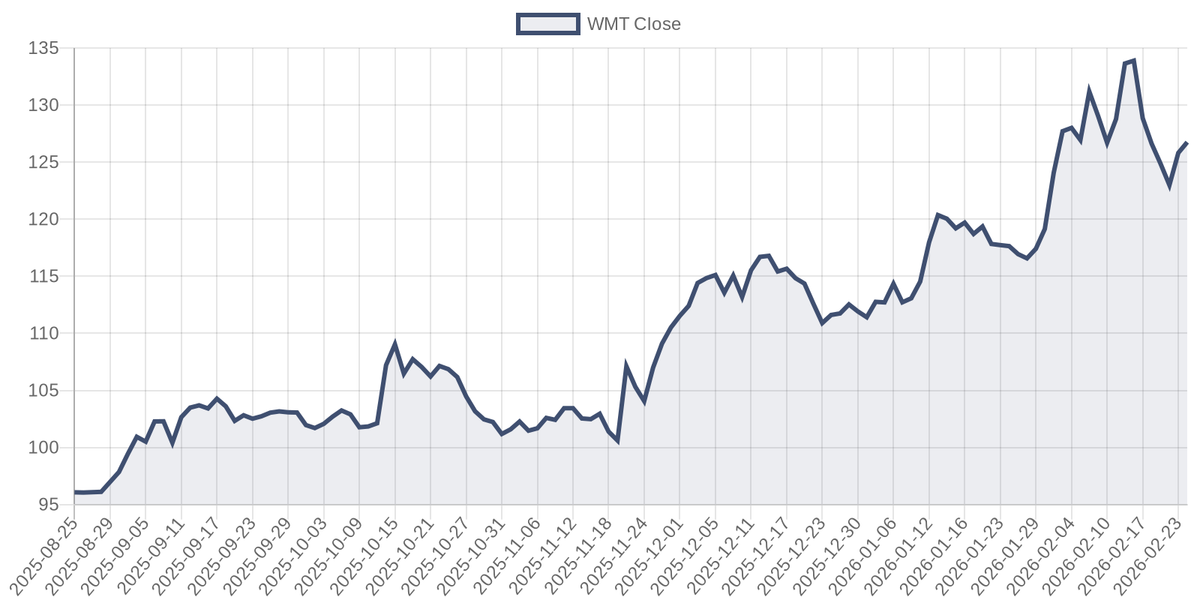
This dynamic—job security mixed with price sensitivity—creates the perfect storm for the "trade-down" effect. Shoppers aren't stopping spending; they are shifting spend toward essentials and discount channels. This directly benefits mega-cap value retailers like Walmart Inc. and Costco Wholesale Corp., which are capturing market share from discretionary peers.
As the chart below illustrates, Walmart has seen sustained momentum over the last six months, decoupling from the broader volatility in tech.
Valuation Risks and The Crowded Trade
The rush into safety has created its own risks. The "Defensive Trade-Down" has become a crowded consensus. Leaders in the space are now trading at historically high P/E multiples, essentially pricing in perfection. If economic data surprises to the upside—confirming a "no-landing" scenario where growth re-accelerates—capital could aggressively rotate back into risk-on Cyclicals, leaving expensive Staples vulnerable.
Upcoming Catalysts
Investors won't have to wait long to test this thesis. Two critical events loom on the immediate horizon:
1. PCE Inflation Data (Friday, Feb 27): The Fed's preferred inflation gauge drops later this week. Sticky services inflation would reinforce the "higher for longer" narrative, validating the defensive rotation. A surprisingly cool print, however, could reignite the bid for Tech.
2. Retail Earnings (Early March): Upcoming reports from Target Corp. and Costco will provide on-the-ground confirmation of whether the trade-down effect is boosting volumes enough to justify these elevated valuations.

The Scouter View
While the market celebrates a daily bounce in Information Technology, the medium-term trend data suggests caution. The flow of funds into Consumer Staples is not just a defensive crouch; it is a bet on a structural shift in consumer behavior for the first half of 2026.
For investors, the edge lies in watching the divergence. If Walmart and Dollar General continue to hold up even on "risk-on" days, the defensive rotation likely has legs. However, with the FOMC meeting approaching on March 18, the window for easy gains in this sector may be closing as valuations stretch.